One blade, ground to outlast a drawer of steel.
Hone is a portfolio concept. Nothing here is for sale.
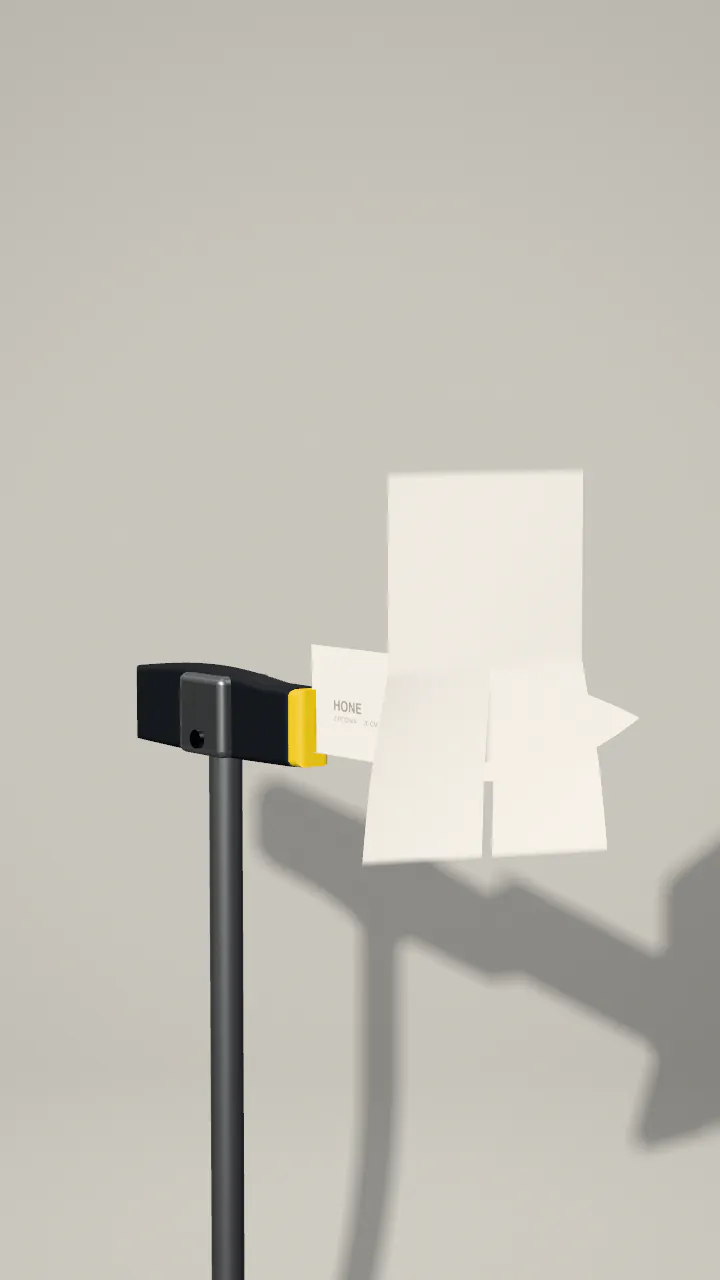
The paper test.
A sheet of paper falls onto the upturned edge and parts in two, in slow motion. Rendered in a browser for this page: no camera, no stock footage.
The paper test, in slow motion.
5 s loop
What the blade is.
Zirconia does not rust and does not react with acidic food. Its edge does not roll, so it never needs a honing steel; diamond restores it on the rare day it needs it.
Blade length, ground from one piece of zirconia ceramic.
The whole knife, handle included.
Mohs figures are typical values for each material. Length and weight are Hone’s demo specification.
Steel dulls because it flexes.
A steel edge rolls a little with each cut. The metal bends at a scale you can’t see, and a rolled edge feels dull long before the blade is worn. Zirconia is harder and stiffer: its edge does not roll, it wears very slowly.
The trade-off is real, and we say it plainly: ceramic chips if it twists sideways against something hard, like a jar lid, a frozen block or another knife in a drawer. It is a blade for cutting, not prying. The care notes below cover the one rule.
The edge rolls over.
The sheath, the plate, the board: as a set or alone.
Every image is a studio render made for this page, and every price is a demo price.
Don’t twist it in a jar opener. That’s the only rule.
Zirconia does not mind a dishwasher’s heat or detergent, but in the rack the blade can knock against other cutlery and chip. Thirty seconds under the tap, dried, back in the sheath.
A hard cutting surface is the single most common way a ceramic edge chips. Wood and composite boards are fine; granite, marble and glass boards are not.
No twisting to pry open a jar lid, no using the spine to crack a shell, no cutting frozen food straight from the freezer. Let it thaw for ten minutes first.
Zirconia’s edge does not roll, so it needs no honing steel. When it finally feels dull, a few passes on the 600 / 1000 diamond plate restore it. A full regrind to the original 15° is a job for a ceramic-rated diamond wheel.
| Blade | Zirconia ceramic (ZrO2) |
|---|---|
| Blade length | 20 cm |
| Edge angle | 15° per side |
| Hardness | About 8.5 Mohs |
| Handle | Glass-fibre-reinforced resin, textured grip |
| Weight | 92 g |
| Dishwasher | Not recommended |
In the kitchen.
“I have chipped one ceramic knife before. This one has done eight months of nightly dinners without a mark, and I finally stopped babying it.”
“It is lighter than I expected the first time I picked it up. That took about a week to stop noticing and start preferring.”
“The diamond plate that comes with the set is enough. Six months in, I have not sent it out for a proper sharpen.”
Questions.
Possibly, if it lands blade first on a hard tile floor. The same is true of most kitchen knives. Dropped on a wooden floor or into a sink, it is usually fine.
No. Zirconia is hard, not tough: it is made for vegetables, fruit, boneless meat and fish, herbs and bread, not bones or anything frozen solid.
Zirconia is chemically inert: it does not rust and does not react with acids, so lemons, tomatoes and onions taste of themselves and the blade does not stain.
No. Hone is a portfolio concept by an independent developer: there is no shop, no stock and no checkout. The cart on this page is a demo that charges, sends and saves nothing.
It is a render. The knife, the clamp and the falling sheet were modelled and drawn frame by frame in a browser for this page, then encoded as a 5-second loop. So were the accessory pictures.

$128. One knife, in one box.
A demo price on a concept page: nothing is charged, and nothing ships.